
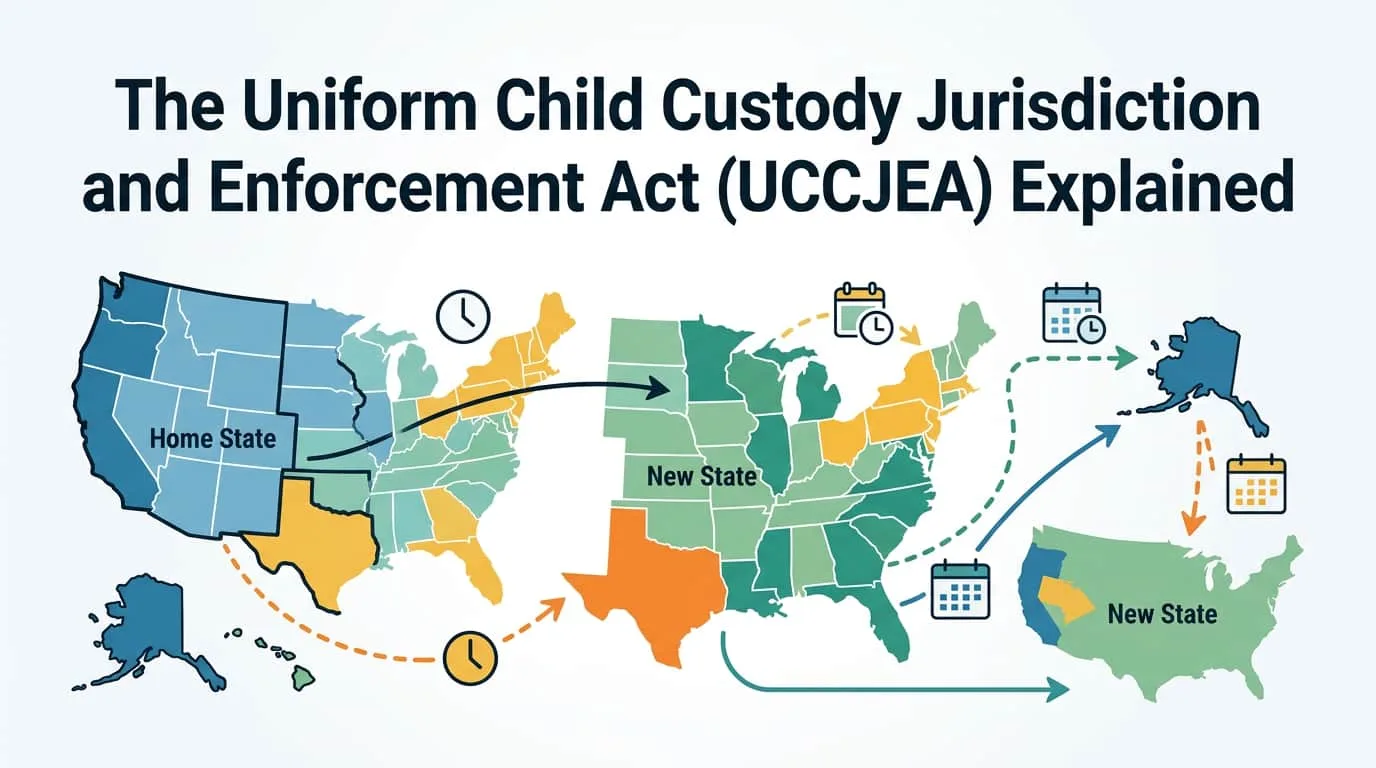
If your ex-spouse suddenly takes your child across state lines, panic sets in immediately. Here in Central Florida, we see these interstate custody nightmares far too often. The Uniform Child Custody Jurisdiction and Enforcement Act (UCCJEA) dictates exactly which state has the legal power to make decisions about your child. If you are facing an abduction threat, contact Ilvento Law at (407) 898-0747 right now for immediate guidance.
Understanding the UCCJEA is critical for any family dealing with custody issues across state or international borders. The rules are highly complex, and making a mistake can jeopardize your parental rights. As a trusted international family law attorney Avalon Park, Florida, we know exactly how to handle these high-stakes disputes.
What Are the Core Principles of the UCCJEA?
The UCCJEA prevents parents from forum shopping to find a favorable judge across state lines. The act establishes clear, uniform rules for which state has jurisdiction over child custody cases. This protects children by ensuring that the state with the closest connection to the family makes all legal decisions.
In our 28 years of practice, our team finds that parents often misunderstand how jurisdiction works. The UCCJEA creates four specific types of jurisdiction: home state, significant connection, emergency, and last resort. These frameworks stop courts in different states from issuing conflicting orders. They also deter parents from kidnapping children to gain a legal advantage in another jurisdiction. When you work with Ilvento Law, we use these rules to build a protective wall around your custody rights.
How Do Jurisdiction and the Home State Rule Work?
Florida becomes a child's "home state" once they live here continuously for six months immediately before a custody action begins. If a parent relocates with a child to Georgia, Florida retains exclusive jurisdiction if the legal process starts within that six-month window.
There are limited exceptions to this strict home state rule. If a child faces immediate danger, a Florida court can exercise temporary emergency jurisdiction. However, this is only a stopgap measure. For long-term custody determinations, Florida courts must establish significant connections to the child. If you live in Winter Park and your child attends school here, Florida has a strong claim to jurisdiction. Navigating these rules requires deep knowledge of family law to ensure your case stays in the right courtroom.
When Can Florida Modify or Enforce Out-of-State Orders?
Florida courts can only modify another state's custody order if the original state completely loses jurisdiction. If everyone moves away from the original state, Florida can step in. For enforcement, Florida courts act fast. Judges can issue warrants to take physical possession of a child within 24 to 48 hours.
Once a Florida court makes an initial custody determination, it holds exclusive, continuing jurisdiction. That means Florida controls the case until neither the child nor the parents have a significant connection to the state anymore. If an out-of-state parent violates an order, expedited enforcement mechanisms come into play. Working with a skilled mediation attorney can sometimes resolve minor disputes, but serious UCCJEA violations require aggressive litigation. An experienced international family law attorney Avalon Park, Florida, will know exactly which motions to file to enforce your rights.
How Does the UCCJEA Interact With Federal Law?
The Parental Kidnapping Prevention Act (PKPA) is a federal law that reinforces the UCCJEA. The PKPA forces every state to give full faith and credit to valid custody orders from other states. If state laws ever conflict, this federal statute overrides them to ensure consistent enforcement nationwide.
The interplay between these laws closes legal loopholes. Before these statutes existed, a parent could flee to another state and legally secure a new custody order. Now, the PKPA mandates that the second state must respect the original state's ruling. This federal backing gives Florida courts the power to demand the return of a child.
What Challenges Do Interstate Custody Cases Face?
International and interstate cases add massive complexity to standard custody disputes. Roughly 75% of our complex custody consultations involve parents terrified of cross-border abduction. While standard litigation can cost $15,000 to $50,000 or more, the emotional toll of a missing child is truly incalculable.
Taking a walk with your kids near Lake Eola shouldn't feel like a security risk. Yet, families facing international threats live with this anxiety daily. Emergency jurisdiction only provides a temporary fix. Securing a permanent, enforceable order takes precise legal strategy. International cases also require compliance with the Hague Convention, which adds another dense layer of legal procedure. You need a highly specialized international family law attorney Avalon Park, Florida, to handle these frightening international complications.
Protecting Your Child's Future in Florida
Navigating jurisdiction rules requires an experienced and authoritative legal team. You cannot afford to make procedural errors when your child's safety is on the line. We understand the local courts, the federal statutes, and the international treaties that govern these disputes.
If you fear your child might be taken out of state, you need to act immediately. Reach out to Ilvento Law at (407) 898-0747 today to secure your family's future.